Disclaimer: This post contains affiliate links. As an Amazon Associate, I earn from qualifying purchases. If you click through and buy any home fitness gear, I receive a small commission at no additional cost to you.
Disclaimer: The information on this blog is for educational purposes only and does not substitute for professional medical advice. Always consult a physician before starting a new exercise program or using home gym equipment.

[AI-generated illustrative image] Image for illustration purposes
Looking for a way to to build strong glutes at home? Limited space and funds? If so, this article may have some interest to you. For many fitness enthusiasts looking to improve the lower body (glutes included), the resistance band has become a popular piece of fitness equipment to answer the questions presented above. Below, we will dive into a number of these resistance band exercises for glutes along with the benefits each exercise provides.
These exercises for glutes are popular because they create continuous tension throughout each movement. Unlike traditional weights that rely mostly on gravity, resistance bands challenge the muscles during both the lifting and lowering phases of an exercise. They are also lightweight, portable, and suitable for beginners as well as advanced fitness enthusiasts.
Resistance Bands … Various Types to Consider In Working Out The Glutes
There are several types of resistance bands used for lower body workouts as well as the glutes. Loop bands, also called mini bands, are excellent for glute activation and smaller movements. Fabric resistance bands are thicker and ideal for exercises like squats and hip thrusts because they don’t roll or slide during workouts. Long loop bands provide greater resistance and are often used for larger movements or progressive strength training.
5 Resistance Band Exercises That Specifically Target The Glutes
Below you will find five highly effective resistance band exercises that specifically target the glutes while improving strength, stability, and muscle endurance. All of these exercises can be performed right from home at a time that meets your schedule. For your convenience, I’ve listed which type of resistance band best fits each exercise with a short video on how to perform. Let’s take a look:
1. Banded Glute Bridges (Video)
The banded glute bridge is one of the best exercises for directly activating the gluteus maximus, the largest muscle in the body. This movement focuses on hip extension, which is the primary function of the glutes.
The resistance band adds outward pressure on the knees, which forces the glute muscles to engage more strongly. This added tension helps prevent the knees from collapsing inward, improving both muscle activation and proper form.
Benefits of Banded Glute Bridges
This exercise is excellent for beginners because it teaches proper glute activation. Many people struggle with “sleepy glutes,” meaning their glute muscles are underused during lower-body movements. Glute bridges help retrain these muscles to fire correctly.
Another benefit is improved hip stability. Strong glutes support the hips and pelvis, which can help reduce lower back strain and improve posture. Athletes also benefit from stronger glutes because they generate more power for activities such as sprinting, jumping, and climbing.
Recommended Resistance Band
A fabric loop resistance band or mini loop band works best for this exercise. Fabric bands are especially helpful because they stay in place during repeated hip lifts.
2. Banded Squats (Video)

[AI-generated illustrative image] Image for illustration purposes
Squats are a classic lower-body movement, and adding a resistance band significantly increases glute activation. The band creates outward tension that encourages the knees to track properly while engaging the glute muscles throughout the movement.
The band forces the glutes to work harder to maintain proper knee alignment, which increases overall muscle activation.
Benefits of Banded Squats
Banded squats strengthen the entire lower body, including the glutes, quadriceps, hamstrings, and hips. However, the added resistance band shifts more focus onto the gluteus medius, an important stabilizing muscle located on the side of the hips.
This exercise also improves joint alignment and movement mechanics. When the glute muscles are strong, the knees are less likely to collapse inward during activities such as running, jumping, or lifting weights.
Another key benefit is versatility. banded squats can be modified with different band strengths or combined with dumbbells for additional resistance.
Recommended Resistance Band
A fabric resistance band or heavy loop band is ideal for banded squats because it provides enough resistance to keep the knees engaged throughout the exercise.
3. Banded Lateral Walks (Video)
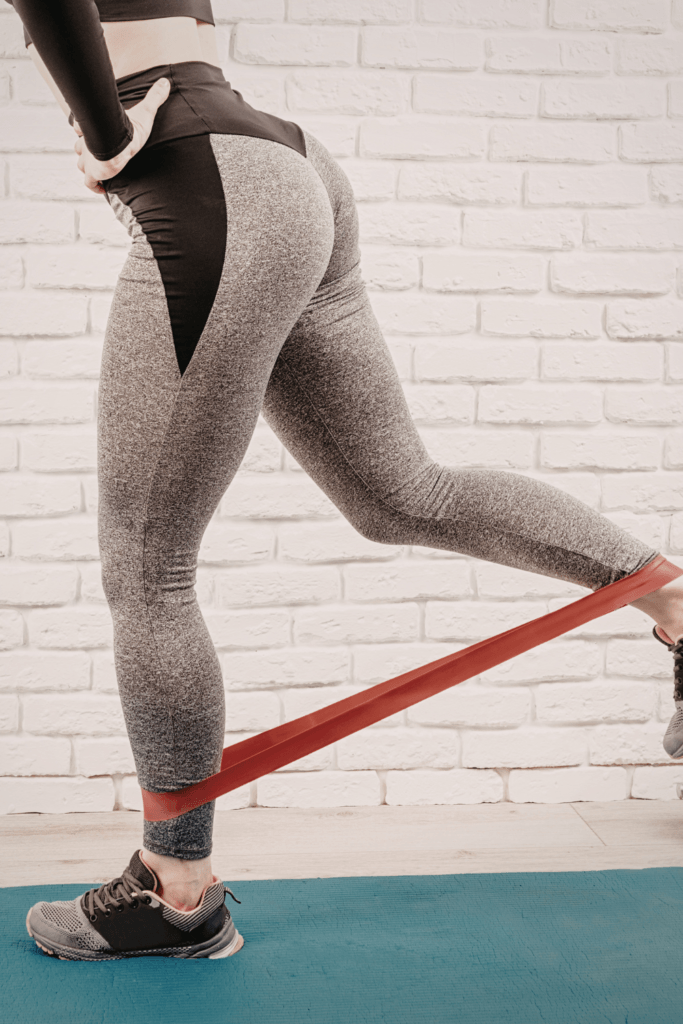
Banded lateral walks are one of the most effective exercises for strengthening the gluteus medius and gluteus minimus. These muscles are responsible for stabilizing the hips during side-to-side movement and maintaining balance during walking or running.
The key to this movement is maintaining tension on the band at all times and avoiding letting the feet come too close together.
Benefits of Banded Lateral Walks
This exercise strengthens the smaller glute muscles that are often overlooked in traditional workouts. Strong glute medius muscles help stabilize the pelvis and reduce the risk of hip, knee, and lower back injuries.
Lateral band walks are also commonly used as a glute activation warm-up before heavier exercises like squats or lunges. Activating the glutes beforehand improves muscle engagement during the workout.
Another benefit is improved balance and coordination. Since the movement requires controlled lateral steps, it trains the body to stabilize during dynamic motion.
Recommended Resistance Band
A mini loop band or light-to-medium resistance band works best for lateral walks because it allows smooth stepping movement while maintaining tension.
4. Banded Donkey Kicks (Video)
[AI-generated illustrative image] Image for illustration purposes
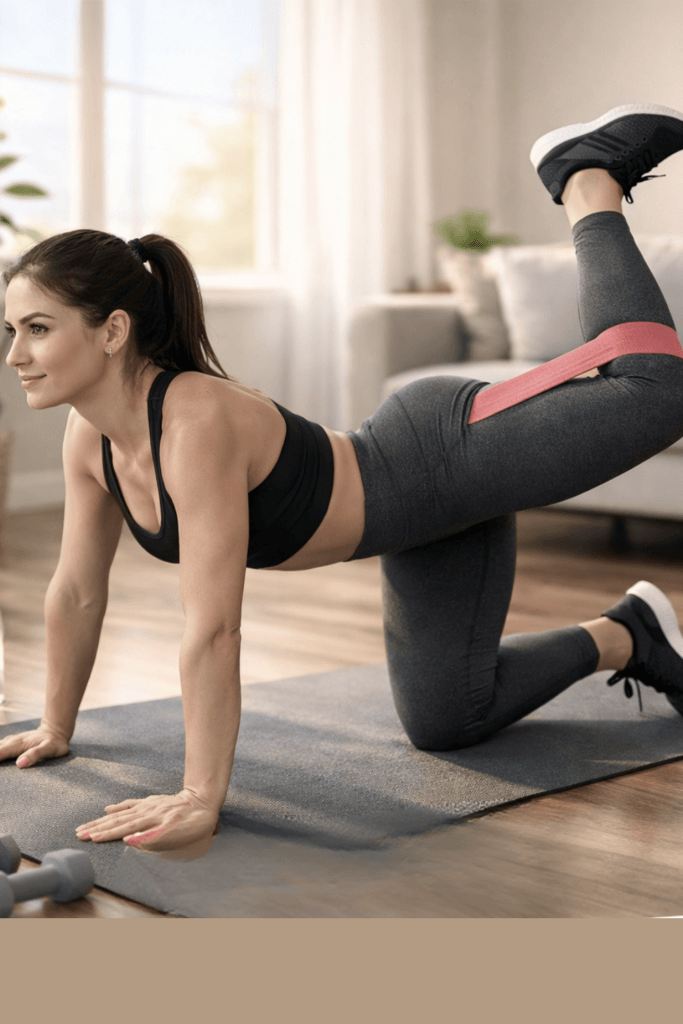
Banded donkey kicks are a simple but highly effective isolation exercise that targets the gluteus maximus. This exercise focuses on hip extension and is excellent for building glute strength and shape.
It’s important to keep your back neutral and avoid arching the lower spine during the movement.
Benefits of Banded Donkey Kicks
One of the biggest benefits of donkey kicks is their ability to isolate the glutes without placing stress on the lower back. This makes them a great option for beginners or individuals recovering from injuries.
The exercise also improves hip mobility and strengthens the muscles responsible for powerful leg drive. Athletes often use donkey kicks to improve sprinting speed and jumping ability.
Additionally, this movement helps build muscular endurance in the glutes, which supports everyday activities such as climbing stairs or standing for long periods.
Recommended Resistance Band
A mini loop resistance band or light fabric band works well for donkey kicks because it provides controlled resistance without limiting movement.
5. Banded Hip Thrusts (Video)
The banded hip thrust is one of the most powerful glute-building exercises available. It targets the gluteus maximus through a full range of hip extension and is commonly used by athletes and strength trainers.
This outward pressure dramatically increases glute engagement.
Benefits of Banded Hip Thrusts
Hip thrusts are known for producing high levels of glute activation compared to many other lower-body exercises. This makes them extremely effective for building glute strength and muscle growth.
Another benefit is improved athletic power. Strong glutes contribute to faster sprinting, higher jumps, and greater lifting strength.
Hip thrusts also support lower back health. When the glutes are strong, they take pressure off the lumbar spine during lifting and daily movements.
Recommended Resistance Band
A heavy fabric loop band or thick hip circle band works best for this exercise because it provides strong resistance while remaining stable during repeated hip lifts.
Suggested Resistance Band Glute Workout
| Exercise | Resistance Band Type | Sets | Reps | Rest Time | Targeted Glute Muscles |
|---|---|---|---|---|---|
| Banded Glute Bridges | Fabric Loop Band or Mini Band | 3 | 12–15 | 45 seconds | Gluteus Maximus |
| Banded Squats | Fabric Resistance Band | 3 | 12–15 | 60 seconds | Gluteus Maximus & Medius |
| Banded Lateral Walks | Mini Loop Band | 3 | 10–12 steps each direction | 45 seconds | Gluteus Medius & Minimus |
| Banded Donkey Kicks | Mini Loop Band | 3 | 12–15 each leg | 45 seconds | Gluteus Maximus |
| Banded Hip Thrusts | Heavy Fabric Loop Band | 3 | 10–12 | 60 seconds | Gluteus Maximus |
How to Structure the Workout
Start the workout with banded glute bridges to activate the glutes. Activation exercises wake up the muscles and help them engage properly during the rest of the workout.
Next move to banded squats, which recruit multiple lower body muscles while heavily targeting the glutes. This compound movement builds strength and power.
After squats, perform banded lateral walks. These help strengthen the smaller stabilizing muscles on the sides of the hips that support balance and knee alignment.
Follow this with banded donkey kicks, which isolate the glute muscles and help improve muscle engagement and control.
Finish the workout with banded hip thrusts, one of the most effective exercises for maximizing glute activation and strength development.
Facts About Resistance Band Training
Resistance bands may appear simple, but they offer several unique advantages compared to traditional weights.
One interesting fact is that resistance bands provide variable resistance. As the band stretches, the resistance increases. This means the muscles work harder at the top of the movement where they are strongest.
Another benefit is joint-friendly training. Resistance bands place less stress on joints compared to heavy weights, making them ideal for beginners, older adults, or individuals recovering from injuries.
Resistance bands are also extremely portable and affordable. A full set of bands can often replace several pieces of bulky gym equipment, making them a great option for home workouts.
Research comparing resistance bands to free weights using EMG (muscle activation) testing has generally found similar muscle activation levels between the two, particularly once the band reaches full stretch — making bands a legitimate strength-training tool, not just a beginner substitute.
Final Thoughts
[AI-generated illustrative image] Image for illustration purposes
In this article, we were able to take a look at the growing trend of resistance bands and how they are used to target the lower body and glutes. In addition, we discovered how resistance band exercises for glutes are a simple yet powerful way to strengthen the lower body without requiring heavy equipment. With the right type of band—such as mini loop bands, fabric resistance bands, or long loop bands— you can perform each exercise with the proper level of resistance.
Thank you for taking the time to read this article and I sincerely hope it has provided some benefits to you. Starting or continuing your fitness routine at home should include the glute exercise with the addition of the resistance band mentioned above. I wish you the best in your workouts!